For thirty years, firms bought software and endured "adoption." Those economics just broke. The cost of building has collapsed, vendors have repriced dependence, and in the AI era the thing you rent out is your own judgment. The new paradigm is Adaptation — building from within.
Rebuilding Stellar Around Conversation
For decades, software gave founders 𝘥𝘢𝘴𝘩𝘣𝘰𝘢𝘳𝘥𝘴 — pages to click through, forms to fill out, workflows to manage.
But that’s not
The Future of Services: How AI-Enabled Operations Will Redefine Service Firms
From financial leverage to capability leverage — why owning delivery creates compounding advantage.
When General Catalyst published “The Future of Services:
For thirty years, firms bought software and endured "adoption." Those economics just broke. The cost of building has collapsed, vendors have repriced dependence, and in the AI era the thing you rent out is your own judgment. The new paradigm is Adaptation — building from within.
Why the next generation of firms will build from within
For thirty years, the software industry ran on one paradigm: Adoption.
The model was simple. A product company builds the best product it can. A digital transformation team goes shopping for the best product in market. And then the whole company embarks on the long, expensive campaign we politely call "adoption" — training, change management, workarounds, dashboards nobody opens, and a quiet resistance that never fully goes away.
If you've ever watched an established firm — an accounting practice, a law firm — attempt large-scale adoption, you know how painful it is. The software wasn't built for them. It was built for a market segment they approximately belong to. Every gap between the product and the firm gets bridged by human effort, forever.
Here's the thing: Adoption wasn't a mistake. It was the rational answer to the economics of its time. When designing, engineering, and building software was extremely expensive, it made sense to build once and amortize across thousands of companies — and it made sense for those companies to buy rather than build. The pain of adoption was the price of sharing the cost.
Those economics just broke.
The new paradigm is Adaptation
The cost of initially building software has collapsed — not to zero, but by an order of magnitude. And the collapse is steepest exactly where firms feel the most pain: the last stretch between a generic product and your actual operation. The internal tools, the workflow engines, the integration and glue layers — the things that used to demand a dedicated team and a year of runway now take a small group of people who deeply understand the business, working in weeks.
I'm not speculating. At my own firm, building our client app and staff portal used to require a product manager, a product designer, a head of engineering, and a five-person engineering team — all full time. Today we're continuing to build both, plus a more complex set of internal tools, with one engineer and about thirty percent of my own capacity. Eight full-time roles, collapsed into one and a bit. That's not a productivity improvement. That's a different economic species.
When the cost of building drops by an order of magnitude, the buy-versus-build question doesn't just tilt — whole categories of software that were once an automatic purchase become candidates for building instead. Building is no longer the expensive part. Fit is the valuable part.
That changes the calculation entirely. Fundamentally, I think the new paradigm is Adaptation.
When you build from within, the product is not bought to be adopted. It forms around the company — around its unique culture, its existing knowledge and infrastructure, its aspirations, and the specific preferences of the small, lean group of people who will run the entire company with high leverage.
The old model gave you a fleet of tanks, managed by a large group of middle managers. The new model is a single Ironman suit, worn by a few powerful orchestrators.
Can't help it. I'm an Ironman fan.
That's not a throwaway metaphor. A fleet of tanks needs a command hierarchy — layers of people whose job is coordinating the machines and each other. An Ironman suit amplifies the person inside it. The organizational implication is that leverage moves up and the coordination layer thins out. The firms that get this will look structurally different, not just technologically different.
Adaptation is not "build everything"
Let me be precise about what I'm not saying. Nobody should rebuild their general ledger, their email server, or their payment rails. The commodity layers — where scale economics are real and the product genuinely is the same for everyone — you buy. But buy them like an owner: on open standards, with substitutable suppliers, and with your exit rights preserved. More on why that discipline matters in a moment.
What you build is the thin layer on top: the layer that encodes how your firm actually operates. Your judgment, your workflows, your client relationships, your way of doing things. That layer was never well served by off-the-shelf software anyway — it's precisely the part every firm used to bridge with human effort and workarounds.
The Ironman suit makes the same point. The suit isn't forged from raw ore. It's assembled from components anyone can source — what makes it formidable is that it's shaped around one specific person. Buy the components. Build the fit.
The honest caveat still applies: cheap to build does not mean free to own. The layer you build has to be maintained and evolved, and that requires the orchestrators to genuinely own it — not delegate it back into the old adoption pattern. Build-from-within is a commitment, not a shortcut. But it's a commitment to something that fits, instead of a permanent tax on something that doesn't.
The other half of the case: dependence has been repriced
Everything above is the offensive argument — Adaptation creates more value. There's a defensive argument too, and it's arrived at the same moment: Adoption now carries more risk than anyone priced in.
Look at what's happened to firms that bet everything on bought software. After Broadcom acquired VMware, customers reported price increases of 800 to 1,500 percent. Oracle now licenses Java by total headcount — every employee, whether or not they've ever touched the language. When Western vendors withdrew from Russia in 2022, the software running banks and airlines went with them. You don't have to operate anywhere near a sanctions regime to absorb the lesson: when a critical layer of your operation sits with a concentrated supplier, the terms can change faster than you can respond.
Notice something about those disasters: they all struck commodity layers — virtualization, a language runtime. The very layers I just told you to buy. That's precisely the point. The problem was never buying commodity; it was buying it from a concentrated proprietary supplier with no substitutes and no exit. The buying discipline matters as much as the build decision. And the one layer nobody else can supply — the layer that encodes how you operate — that one you build and own outright, so no one can reprice it, and no one can weld the exit door shut.
These are two halves of the same case. Adaptation creates more value than Adoption ever could. And Adoption has quietly become more dangerous than it looks on the procurement spreadsheet.
The extraction problem
There's a deeper shift underneath the repricing. SaaS lock-in was always about the cost of leaving. The AI era introduces something worse: what you no longer own even if you stay.
The SaaS-era deal, at its core, was: you rent the software, you keep the data. Data was the durable asset and it was (mostly) exportable — your customer records, your ledger, your files could walk out the door with you. The AI-era deal is structurally different. To make an agentic system perform your work, you have to externalize your judgment into it — how you decide, what you'd approve, how you handle the edge cases, the tacit knowledge of your veteran GM. And unlike data, encoded judgment is not portable. There is no "export" button for what a vendor's models have learned from your firm. Even if you can extract your raw records, you cannot extract the improvements your knowledge produced in their system. So the extraction is one-directional and the value accretes to an asset the vendor owns — which is precisely why pricing power lands with them. Your differentiation becomes their moat, and you rent your own judgment back at whatever the renewal says.
A "we don't train on your data" clause doesn't fix this. The mechanism varies, but the direction is constant: your prompts, your configurations, your workflow logic, your evaluation criteria — everything that makes the agent behave like your firm — gets encoded in the vendor's platform, in the vendor's formats, non-portable by construction. And vendors learn from aggregate usage patterns at the product level — which workflows their customers run, where agents succeed and where they fail — regardless of what any individual contract says.
The obvious objection: doesn't building from within just move the dependency down a layer, onto rented foundation models? No — and the difference is the whole game. Models are becoming a substitutable commodity: multiple competing suppliers, and your prompts, workflows, and encoded judgment travel across them, if you own them. The danger was never renting the model. The danger is renting the platform that stores your judgment in its proprietary formats. Rent the engine. Own the suit.
So the real question of the agentic era is simply this: where does the compounding accrue? Rent your judgment layer, and the intelligence compounds inside the vendor. Build it from within, and it compounds inside your firm.
The customer never sees the seam
Now extend the thinking outward, to how the firm's customers already engage with it.
Under the Adoption paradigm, technology change is something customers experience — usually as friction. A new portal. A new login. A chatbot they didn't ask for, standing between them and the person they trust.
Under Adaptation, the customer experiences no abrupt change at all. It's not a new chatbot your customer has to learn to talk to. It's an invisible intelligent being — interacting with your customer in the same channel your veteran GM has been using with those same customers for the past ten years.
The relationship stays. The channel stays. The intelligence behind it compounds.
To be clear: invisible does not mean deceptive. The relationship stays human and stays accountable — your GM is still the person your customer trusts, and still answerable for everything that gets said. The intelligence works behind the channel, not in disguise inside it.
This, to me, is the tell that separates the two paradigms:
Adoption announces itself: new tools, new interfaces, new behaviors demanded of everyone inside and outside the firm.
Adaptation is silent. The firm simply gets faster, more consistent, more capable — and neither the staff nor the customers can point to the moment it happened.
What this means
If you run a firm — especially a professional services firm sitting on decades of relationships and institutional knowledge — the question is no longer "which product should we adopt?"
The question is: which layers of your operation are commodity, and which layer encodes what makes you you? Who are the few people in your firm capable of wearing the suit? And what would your firm look like if that layer were formed around them, instead of the other way around?
The companies that answer those questions first won't look like they transformed. They'll look like they always worked this way.
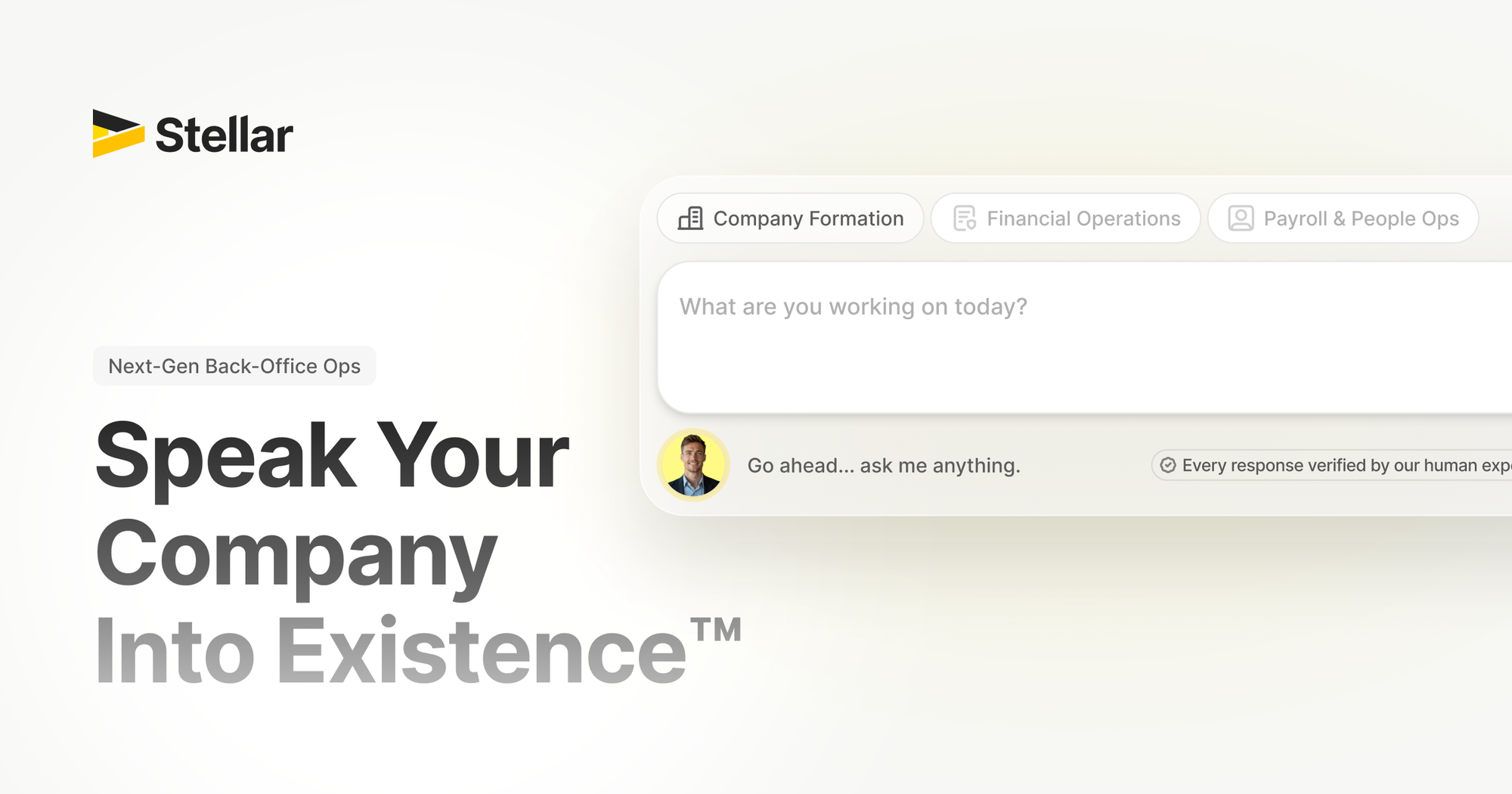
For decades, software gave founders 𝘥𝘢𝘴𝘩𝘣𝘰𝘢𝘳𝘥𝘴 — pages to click through, forms to fill out, workflows to manage.
But that’s not how you actually run a company. You run it through 𝘤𝘰𝘯𝘷𝘦𝘳𝘴𝘢𝘵𝘪𝘰𝘯𝘴: with a team of trusted professionals.
You could say — founders run companies 𝘵𝘩𝘳𝘰𝘶𝘨𝘩 𝘤𝘰𝘯𝘷𝘦𝘳𝘴𝘢𝘵𝘪𝘰𝘯𝘴. So we decided to rebuild Stellar around that simple truth.
And today, the first version of that new interface goes live.
It’s not a finished product — it will grow, evolve, and improve.
But it marks a clear shift: — From searching for information and reading… to simply 𝘢𝘴𝘬𝘪𝘯𝘨 — From juggling tasks and back-office functions… to having things 𝘥𝘰𝘯𝘦 𝘧𝘰𝘳 𝘺𝘰𝘶
You simply start a conversation with one of us. Everything flows from there.
On Stellar, human and AI agents now work together to help you start and operate your company.
Here’s how it works: ↳ You message: “I need to incorporate a Delaware C-Corp.” ↳ Our agent asks about your business, ownership structure, and timeline ↳ It prepares the formation documents ↳ It brings in our incorporation specialists and legal counsel to review your equity setup ↳ It prepares to file with the state ↳ You approve — and it’s done
No forms to hunt down and fill. No workflows to manage. No wondering if you missed something.
Just going from conversation → to completion.
This same approach now extends across everything we do: Incorporation. Compliance. Payroll. Bookkeeping. Tax. And more.
All the invisible infrastructure of running a business — accessible through a single conversational interface.
It’s early. It’s imperfect. But we believe it’s the right direction.
We’re building toward a future where you don’t manage a company through clunky tools and dashboards — but through simple, natural conversations.
Technology builders can capture greater value by directly owning and operating the service businesses that deliver their innovations to end customers.
In other words, the future belongs to those who operationalize technology, not just develop it.
At Stellar, we’ve been preparing for this future for several years. We didn’t set out to “build an AI-enabled roll-up.” We set out to solve the structural inefficiencies in service delivery — to create a model where knowledge, technology, and human expertise reinforce one another.
In hindsight, that’s precisely what General Catalyst is describing.
Anticipating the Convergence of Technology and Services
Traditional service businesses — in accounting, compliance, or corporate administration — have long been constrained by the limits of human throughput and fragmented systems.
Meanwhile, software firms often stopped short of the last mile: their tools enhanced productivity but didn’t fundamentally change service delivery.
The opportunity now lies at the intersection — where service execution becomes a capability that compounds through technology.
At Stellar, we began building the foundations for this model years ago:
A unified operating platform that brings together formation, compliance, payroll, bookkeeping, and CFO functions across multiple jurisdictions.
Structured knowledge bases and AI agents trained on proprietary service data, enabling consistency, accuracy, and decision support across teams.
A modular integration framework designed to absorb new service lines or acquisitions seamlessly, standardizing processes and data from day one.
Each of these elements serves a single objective: to convert what has traditionally been human tacit knowledge into explicit, interoperable systems — so that service excellence can scale.
From Vision to Realization
The vision described by General Catalyst is entirely achievable. But realizing it requires more than conviction; it demands depth, precision, and disciplined execution.
AI doesn’t inherently transform a service business — it amplifies whatever operating model it’s applied to.
In practice, that means success depends on a few non-negotiable foundations:
Systemic process design.The organization must operate as a coherent system, not a collection of disconnected workflows. Processes need to be observable, measurable, and replicable across teams and regions.
Data architecture and integrity.Information — from client records to compliance filings — must exist in a structured, machine-readable form. Without this foundation, automation introduces more error than efficiency.
Organizational alignment.Transformation requires cultural readiness. Teams must understand not just what is changing, but why — and see technology as a multiplier of their capability, not a threat to their role.
At Stellar, much of our early effort went into this groundwork: mapping service flows, codifying operational logic, and creating common taxonomies for data and services.
Because intelligence compounds only when structure exists.
Executing the AI-Enabled Roll-Up
The difference between a financial roll-up and an AI-enabled one is profound.
A traditional roll-up captures financial arbitrage — buying fragmented service providers, consolidating overhead, and improving margin.
An AI-enabled roll-up captures capability arbitrage — integrating technology into the operating core, so each acquisition strengthens the platform’s intelligence and throughput.
This distinction changes the growth equation.
Instead of chasing economies of scale, you’re creating economies of learning — where every new business integrated into the platform enhances collective capability.
In practice, this means embedding technology into delivery workflows, centralizing data, and continuously retraining systems to improve quality and speed.
It also requires governance discipline — to ensure each acquisition aligns with a shared operational model and cultural DNA.
Why This Moment Is So Exciting
While the operational demands are real, this is one of the most promising transformations in the modern business landscape.
Three factors make it particularly compelling:
Rebundling creates defensibility.By integrating technology and service delivery, companies become embedded in the daily operations of their clients. The result is deeper relationships, higher retention, and stronger barriers to entry.
Capability compounds faster than capital.When knowledge, data, and automation reinforce one another, productivity growth outpaces headcount growth. The platform becomes smarter — not just larger — with each transaction.
Global expansion becomes viable.Standardized processes and AI-enabled workflows reduce the marginal cost of entering new markets. What once required 200 people per country can now be achieved with 30 — without compromising quality or compliance.
For operators and investors alike, this model redefines what a “services business” can be: intelligent, scalable, and outcome-oriented.
Closing Reflection
The convergence of AI and services is not a speculative future; it’s already unfolding.
But sustainable success will favor those who build for substance, not headlines — who combine vision with operational depth.
At Stellar, we view this as a once-in-a-generation opportunity to rebuild how service industries operate — to turn institutional knowledge into scalable infrastructure and deliver true capability-led growth.
It’s a challenge worth taking on.
And if we execute it well, it won’t just reshape our industry — it will redefine what it means to operate a company in the age of intelligent systems.